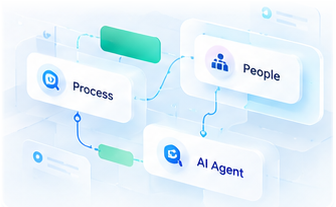
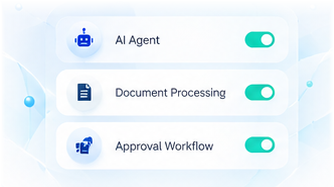
01

Connect
Connect systems and data across the operating environment.
CORPORATE PRODUCT / IN DEVELOPMENT
Business Transformation &
Orchestration Platform
Transform without starting over.
Connect existing systems with people, process and AI. Move toward measurable outcomes — without starting over.
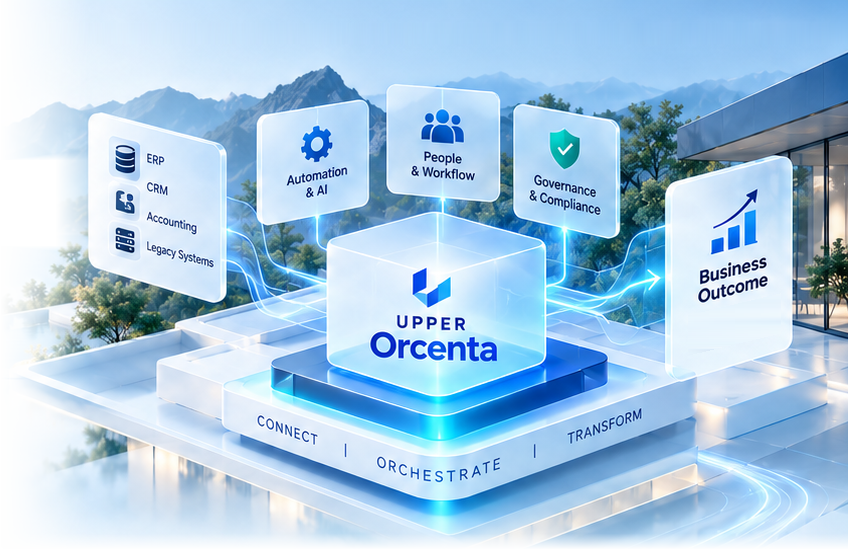
Connect systems and data across the operating environment.
Coordinate process and people across system boundaries.
Automate repeatable work with governed automation and AI.
Measure outcomes and operational evidence for continuous improvement.
VISUAL LANGUAGE & DESIGN DIRECTION
A product expression within UPPER INNOVATION CI: minimal, spacious, trustworthy and product-specific.
Clean, focused and intentionally restrained.
Make value and structure easy to scan.
Contemporary technology with enterprise trust.
Distinctly Orcenta while remaining within CI.
WHY ORCENTA EXISTS
Many organizations already have systems that work. The real problem is often the gaps between systems, teams, approvals, automation, AI and outcome measurement.
Orcenta focuses on those gaps first.
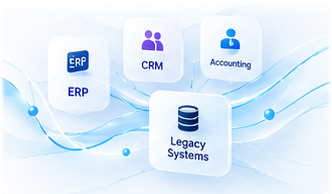
Fragmented systems
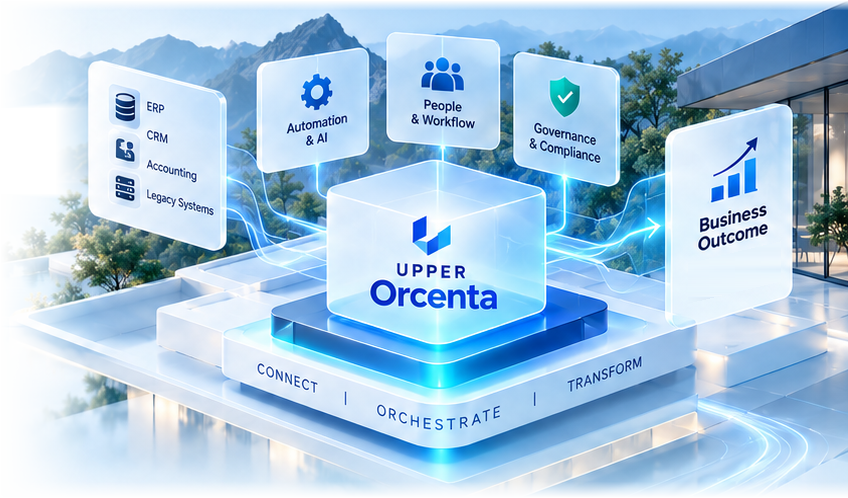
UPPER Orcenta
Governed business flow
OPERATING LOOP
Turn fragmented systems and work into an evidence-driven improvement loop.
systems, data, APIs and evidence
→process, context and operational state
→governed repetitive work
→bounded AI assistance with explicit authority
→outcomes, exceptions and evidence
→feed evidence into the next cycle
THREE OPERATING MODES
Keep what works. Improve around it.
For organizations with useful existing systems that should not be replaced wholesale.
Change selectively without losing process continuity.
For organizations replacing CRM, ERP or other systems in stages.
Design the operating stack from the business need.
For new businesses, business units or operating models that want a new technology stack with Orcenta as the orchestration layer.
WHAT MAKES ORCENTA DIFFERENT
Start from the business problem and measurable outcome.
Existing and future systems remain replaceable.
Work with what exists without limiting new builds.
AI acts only within defined data, tool and authority boundaries.
Business-critical actions can remain explicitly controlled by people.
Audit, outcome lineage and observability are architecture concerns rather than afterthoughts.
SEVEN CORE DOMAINS
Connect business systems, data, APIs and evidence sources.
Define and coordinate business processes across system boundaries.
Run governed workflows and reduce repetitive manual work.
Use bounded AI assistance within explicit data, tool and authority limits.
Apply permissions, policy, human approval, audit and governance.
Understand operational state, exceptions and evidence.
Measure business outcomes and feed evidence into the next improvement cycle.
Governance applies across all domains.
WHO SHOULD FOLLOW ORCENTA
operate across multiple business systems
want automation without creating another isolated tool layer
want to introduce AI with explicit governance and human oversight
are planning staged ERP/CRM modernization
are creating a new business unit or operating model
want transformation measured through business outcomes rather than software deployment alone
WHAT EXISTS TODAY
Private engineering evidence already covers bounded implementations of:
Currently under active product development. Public production availability and General Availability have not been announced.
These are private development and synthetic validation scopes. They do not establish General Availability, production readiness, customer-data readiness or customer business outcomes.
WHAT WE ARE BUILDING TOWARD
NEXT STEP
If your organization is dealing with disconnected systems, manual handoffs, fragmented automation or uncertainty about how to introduce AI safely, Orcenta is being built around exactly that problem space.